What "footsites" means
In sneaker slang, "footsites" refers to the family of storefronts operated by Foot Locker, Inc. and closely related banners, such as Foot Locker, Champs Sports, Kids Foot Locker and their international versions. They share similar technology and defences, so a proxy setup that works on one often works on the others, though performance can vary by banner and region.
Footsites are among the most popular targets for sneaker bots, which is exactly why they invest heavily in bot protection. This guide covers how proxies fit. For general background, see sneaker proxies.
How footsites defend against bots
- Commercial bot protection that scores each visitor using IP, fingerprint and behaviour.
- Virtual queues on hyped releases.
- Per-IP and per-session rate limits.
- Order review and cancellation for linked or suspicious orders.

Recommended proxies
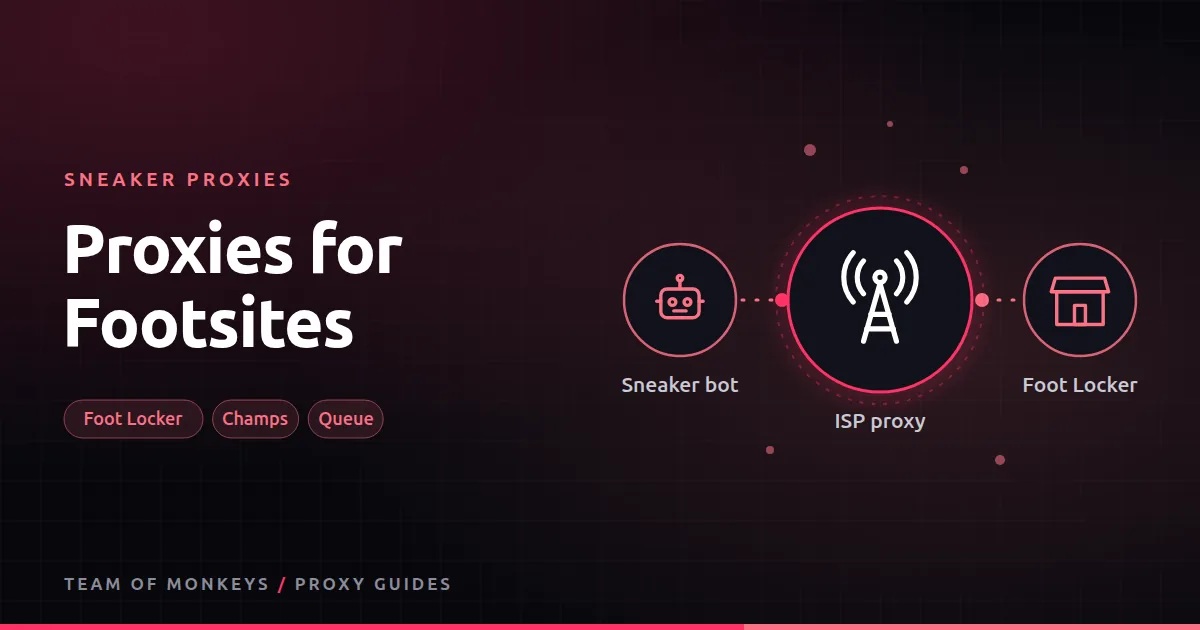
ISP proxies are the standard choice for footsites. They provide residential-looking IPs with server speed and static stability through queues and checkout.
What to look for in footsite ISP proxies:
- Tested on footsites recently. Ask sellers which banners and regions the batch performs on.
- Region. US footsites typically perform best with US proxies, often East Coast. UK and EU footsites need proxies in those regions. See US proxies and UK proxies.
- Subnet diversity. Spread tasks across several subnets.
- Dedicated IPs.
Residential proxies can also work, especially for account-related tasks, but they're slower through queues and checkout.
Queue behaviour and sticky IPs
When a footsite places you in a queue, your position is tied to your session. Changing IP mid-queue can lose your place. This is another reason static ISP proxies are preferred over rotating residential for footsites. If you use residential, use long sticky sessions.
Task-to-proxy ratio
Footsites are stricter than many Shopify stores. One task per proxy is the standard recommendation. Running multiple tasks per IP increases the chance of throttling or bans. See how many proxies for a sneaker bot.
Proxy tip: If you need region-matched IPs, Geonode residential proxies can be targeted by country, state or city, and sticky sessions can hold the same IP for up to 24 hours. Our guide to Geonode for sneaker bots shows how cooks combine them.
Server location
Run your bot on a server in the same region as your proxies. Many US cooks use East Coast servers with East Coast ISP proxies for US footsites. See sneaker bot server location.
Avoiding bans
- Don't run monitors on checkout proxies.
- Don't test proxies by hammering the site repeatedly before release.
- Keep accounts, cards and addresses distinct and realistic.
- Rest proxies that were heavily used on the previous release.
See why sneaker proxies get banned.
A footsite release checklist
| When | Task |
|---|---|
| A few days before | Buy ISP proxies in the right region; confirm seller has recent footsite results |
| Day before | Test proxies against the footsite once; remove failures; spread tasks across subnets |
| Day before | Confirm server is in the same region as proxies |
| Release morning | Single retest; start tasks per your bot's guidance |
| During release | Watch errors; switch to backup group if a subnet fails |
| After | Log results per subnet |
Regional footsite storefronts
Footsite storefronts exist in several countries. Each may have its own infrastructure and protection settings:
- US banners: US ISP proxies, often East Coast.
- Canadian storefronts: Canadian or nearby US proxies, depending on availability and site behaviour.
- UK and EU storefronts: London and EU ISP or residential proxies.
- Asia-Pacific storefronts: country-matched residential where ISP isn't available.
Account considerations
Footsite releases may involve accounts, loyalty programmes or launch reservations. Keep each account on a consistent IP and device, and keep profiles distinct and legitimate. Proxies don't fix linked accounts or duplicate payment details. See why sneaker proxies get banned.
Budget tip: For jobs where a fixed IP list is enough, Webshare is one of the cheapest options: shared datacenter proxies are sold by the IP, and static residential (ISP) proxies cost well under a dollar per IP per month at the time of writing. More in Webshare for sneaker bots.
Speed tuning
- Server and proxies in the same region.
- Drop the slowest 10 to 20% of proxies after testing.
- Avoid overloading the server with too many tasks.
See sneaker proxy speed and sneaker bot server location.
After a footsite release: reading your logs
The hour after a release is the best time to improve your next one. Pull your bot's logs while they're fresh and look at proxies, not just results:
| What to look at | What it tells you |
|---|---|
| Queue pass rate per proxy group | Which seller or subnet is getting through waiting rooms |
| 403 and challenge counts per IP | Which IPs are flagged and should be replaced or rested |
| 429 counts and timing | Whether your request rate, not your IPs, triggered limits |
| Tasks dropped from the queue | Whether IPs changed mid-queue or sessions expired |
| Response times per group | Whether slow peers or a distant server held you back |
Then act on it:
- Rest or replace IPs with repeated 403s on this retailer. Note them in your ban log.
- Lower task counts on groups that drew 429s before blaming the proxies.
- Check sticky behaviour if tasks dropped from queues; your sessions may be shorter than the queue.
- Message your seller with specifics for replacements: IPs, site, times and error codes.
Keep a one-line summary per release in a spreadsheet: site, proxy groups, pass rate and notes. After a few releases, the patterns are obvious. See why sneaker proxies get banned, sneaker proxy speed and how many proxies for a sneaker bot.
For a third option, read Rayobyte for Sneaker Bots; our Rayobyte vs Geonode vs Webshare for Sneaker Bots comparison shows where Rayobyte, Geonode and Webshare each come out ahead.
Residential tip: If you want to try this on an ethically sourced residential pool, Rayobyte offers a free trial with no credit card, then pay-as-you-go traffic from $3.50 per GB that drops to $0.70 per GB at 1 TB. See Rayobyte for sneaker bots.
Key takeaways
- Footsites share technology and strong bot protection; ISP proxies in the right region are the standard choice.
- Queue positions are tied to sessions and IPs, so avoid rotating mid-queue.
- One task per proxy is the norm.
- Pair proxies with a server in the same region and test once before releases.
- Keep accounts and payment details distinct and legitimate. See best proxies for sneaker bots.
For a provider comparison that goes beyond sneaker sellers, see our guide to the best proxies in 2026.
FAQ
Do footsites ban datacenter proxies?
Generally, yes, on hyped releases.
Should I use different proxies for each footsite banner?
Not necessarily, but track performance per banner; a subnet can do well on one and poorly on another.
What's the best region for US footsites?
Many cooks favour US East, but test against each release.
Sources and further reading
Independent references that back up the points above, from standards bodies, governments, universities and non-profits. They open in a new tab.
- Automated Threats to Web Applications (OWASP): OWASP's catalogue of automated threats, including scraping and scalping, as site owners see them.
- Number Resources (IANA): How IANA hands IP address blocks to the regional internet registries.
- RFC 6265: HTTP State Management Mechanism (Cookies) (IETF / RFC Editor): The cookie standard, which ties a session together regardless of IP.
- 429 Too Many Requests (MDN Web Docs (Mozilla)): What a 429 response means and how servers use it.
- RFC 9293: Transmission Control Protocol (TCP) (IETF / RFC Editor): The current TCP specification, the transport under HTTP and SOCKS proxies.
Editorial note: Proxy providers change their pools, features and prices often, so treat any figures here as typical ranges at the time of writing and confirm current terms with the provider before you buy.