The tools
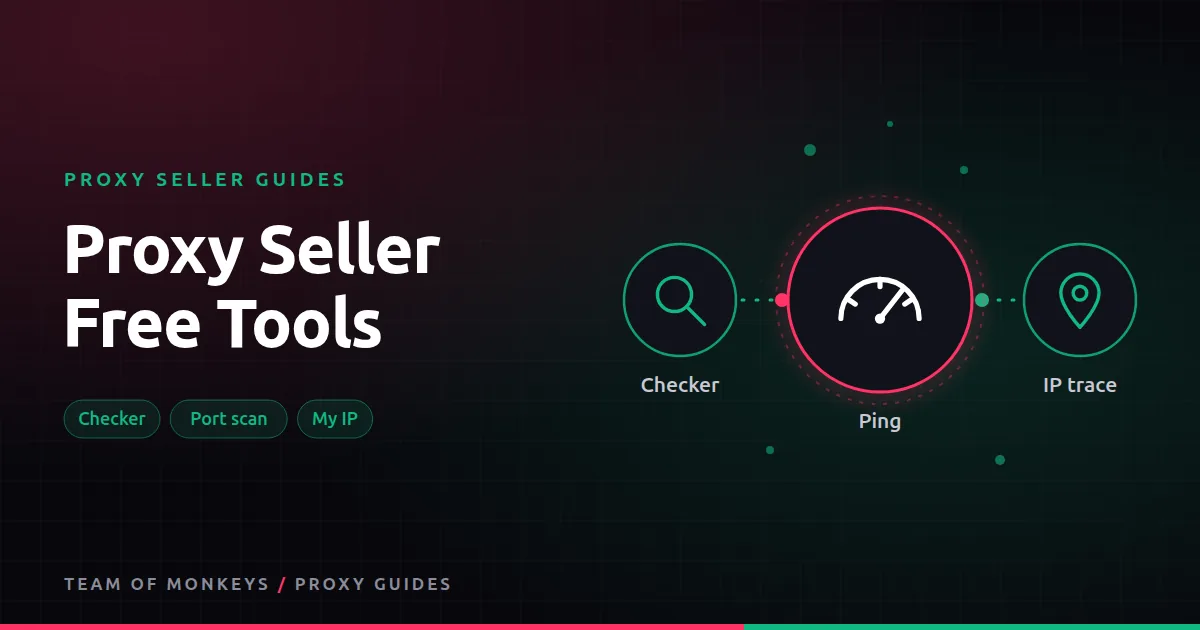
Proxy Seller lists five free tools in its site menu (checked 20 November 2026):
| Tool | What it does | Use it to |
|---|---|---|
| Proxy-Check | Tests whether proxies are alive and responding | Check a list after purchase |
| Port-Scanner | Checks which ports are open on a host | Debug connection problems |
| Ping-IP | Measures response time to an IP | Compare latency between proxies |
| My IP | Shows the IP and details a site sees | Confirm the proxy is in use |
| IP-Trace | Looks up an IP's location and network | Check country and ISP |
A five-minute post-purchase check
- Paste your new list into Proxy-Check and remove any dead proxies.
- Connect through one proxy and open My IP: the IP should be the proxy's, not yours.
- Run IP-Trace on a few IPs to confirm country and ISP match your order.
- Ping a sample to spot unusually slow ones.
- Report problems to support within 24 hours (see the refund policy).

Coupon tip: Before you scale, buy a small order from Proxy Seller with code MONKEYS (15% off), test it on your real targets, and use the 24-hour refund or replacement window if it fails. See whether Proxy Seller has a free trial.
What the tools can't tell you
A proxy can be alive, fast and in the right country, and still be blocked on your target. The only real test is your own workload on your own targets. Our how to test proxies before buying and how to check if a proxy is working guides go further.
For the wider picture, our best proxies guide ranks proxy types by job, cheap proxies shows how to cut costs, and buy proxies walks through the purchase step by step.
Proxy tip: A good way to compare providers is to run the same test plan on each. Geonode makes that cheap to do because you can buy a small amount of residential bandwidth and use it at your own pace. See our Geonode proxies guide.
Key takeaways
- Five free tools: Proxy-Check, Port-Scanner, Ping-IP, My IP and IP-Trace.
- Use them straight after buying, inside the 24-hour window.
- Always test on your real targets too.
Budget tip: For jobs where a fixed IP list is enough, Webshare is one of the cheapest options: shared datacenter proxies are sold by the IP, and static residential (ISP) proxies cost well under a dollar per IP per month at the time of writing. More in Webshare's free proxy plan.
Residential tip: If you want to try this on an ethically sourced residential pool, Rayobyte offers a free trial with no credit card, then pay-as-you-go traffic from $3.50 per GB that drops to $0.70 per GB at 1 TB. See the Rayobyte free trial.
FAQ
Are Proxy Seller's tools free?
Yes. They are listed in the site menu and don't require a purchase.
Can I check proxies from other providers?
The tools test any proxy or IP you enter, not only Proxy Seller's.
Do I need an account to use the tools?
They are listed in the public site menu; you don't need to buy proxies to use them.
Sources and further reading
Independent references that back up the points above, from standards bodies, governments, universities and non-profits. They open in a new tab.
- Nmap (Nmap project): The open-source network scanner, useful for checking which proxy ports are open.
- RFC 9293: Transmission Control Protocol (TCP) (IETF / RFC Editor): The current TCP specification, the transport under HTTP and SOCKS proxies.
- RFC 9110: HTTP Semantics (IETF / RFC Editor): The HTTP standard that defines how proxies, tunnels and the CONNECT method behave.
- Autonomous system (Internet) (Wikipedia): What an autonomous system (ASN) is, the network label sites use to tell datacenter IPs from home ones.
- User-Agent header (MDN Web Docs (Mozilla)): What the User-Agent header reveals about your client.
Editorial note: Proxy providers change their pools, features and prices often, so treat any figures here as typical ranges at the time of writing and confirm current terms with the provider before you buy.