What you get
IPv6 is the newer internet address format, with so many addresses that providers can sell them for cents. Proxy Seller is the only one of our four partners that sells IPv6 proxies. From proxy-seller.com on 20 November 2026:
| Feature | Proxy Seller IPv6 |
|---|---|
| Price | From $0.02 per IP |
| Pool | 1.2M+ unique IPs |
| Type | Dedicated: each IP is assigned to one customer for the rental term |
| Rental periods | 1 week to 12 months |
| Order sizes | Presets from 10 to 5,000 IPs, or an exact number |
| Protocols | HTTP, HTTPS, SOCKS5 |
| Authentication | Username and password, or IP allowlist |
| Bandwidth | Unlimited |
| Speed | Up to 1 Gbps |
| Delivery | Instant after payment |
How it works
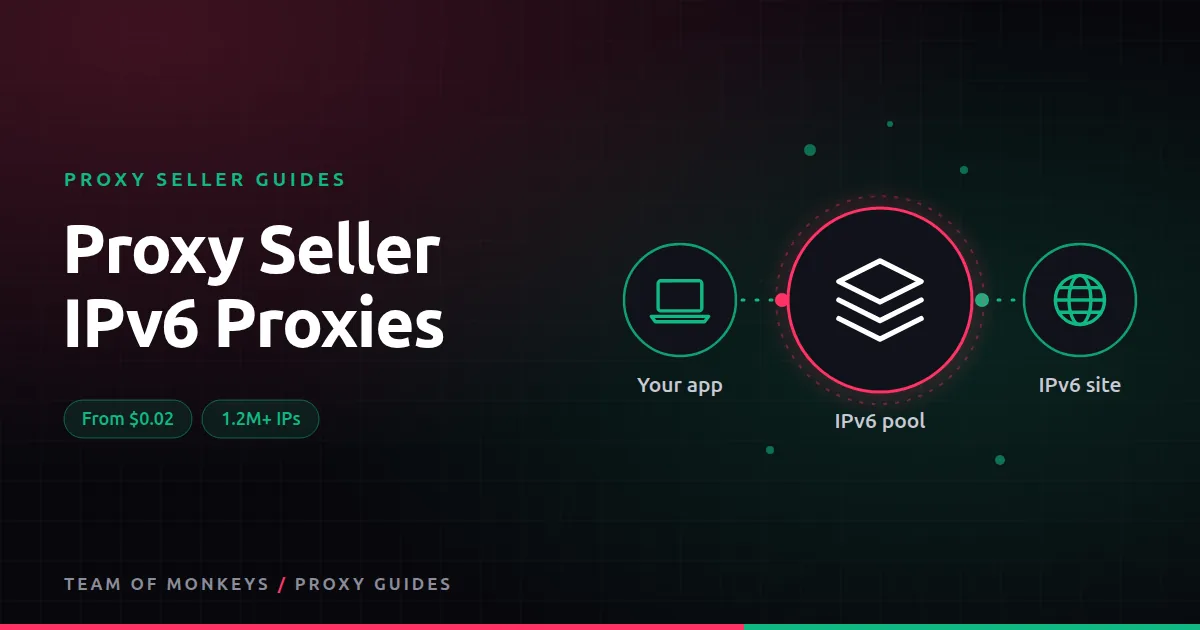
You connect to the proxy over an ordinary IPv4 address, and each proxy gets its own port. The proxy then sends your request out to the website over IPv6. Proxy Seller doesn't translate between the two, so the website must support IPv6. If it doesn't, the request fails. Our general IPv6 proxies guide explains the background.

Which sites accept IPv6
Proxy Seller's FAQ names Instagram, Facebook, TikTok, YouTube, Google, Amazon, eBay, Cloudflare-protected sites, GitHub and Netflix as working with IPv6. It also warns that many services don't support IPv6, and recommends testing first. That is good advice. Support changes over time and can differ between a site's main domain and its API or image servers.
A quick check: look up the target domain's AAAA DNS record. If there isn't one, the site doesn't accept IPv6 traffic.
Coupon tip: Before you scale, buy a small order from Proxy Seller with code MONKEYS (15% off), test it on your real targets, and use the 24-hour refund or replacement window if it fails. See our complete Proxy Seller guide.
Why IPv6 is so cheap, and the catch
Because IPv6 space is enormous, providers can hand out thousands of addresses cheaply. Sites know this too. Many rate-limit or block whole IPv6 ranges (often by /64 block) rather than single addresses, so a list of 1,000 IPv6 proxies from one block might be treated as one user. Ask how the addresses are spread, and test with realistic volumes before buying a big list.
Proxy Seller's own pages disagree on whether IPv6 is more or less anonymous than IPv4, which tells you the honest answer: it depends on the target.
Good uses
- Large scraping jobs on IPv6-ready sites, where thousands of dedicated IPs cost less than a few dozen IPv4s. See Proxy Seller for web scraping.
- Social media and Google tasks, on the services that accept IPv6, after testing.
- Testing and development, where you need many distinct IPs cheaply.
If a target doesn't support IPv6, use IPv4 proxies instead.
Proxy tip: A good way to compare providers is to run the same test plan on each. Geonode makes that cheap to do because you can buy a small amount of residential bandwidth and use it at your own pace. See our Geonode proxies guide.
Pricing and the coupon
From $0.02 per IP, and code MONKEYS takes 15% off. A thousand IPv6 proxies at the headline price come to about $20 before the discount and $17 after. Start with a small order for one week to test your targets. See Proxy Seller pricing, or our buy IPv6 proxies guide for buying tips.
For the wider picture, our best proxies guide ranks proxy types by job, cheap proxies shows how to cut costs, and buy proxies walks through the purchase step by step.
Key takeaways
- Dedicated IPv6 proxies from $0.02 per IP, from a pool of 1.2M+ addresses.
- You connect over IPv4; the request leaves over IPv6, so the target must support IPv6.
- Test every target first; some block whole IPv6 ranges.
- Only Proxy Seller sells IPv6 among our four partners. Use code MONKEYS for 15% off.
Budget tip: For jobs where a fixed IP list is enough, Webshare is one of the cheapest options: shared datacenter proxies are sold by the IP, and static residential (ISP) proxies cost well under a dollar per IP per month at the time of writing. More in Webshare vs Geonode.
Residential tip: If you want to try this on an ethically sourced residential pool, Rayobyte offers a free trial with no credit card, then pay-as-you-go traffic from $3.50 per GB that drops to $0.70 per GB at 1 TB. See Rayobyte vs Geonode vs Webshare.
FAQ
Do IPv6 proxies work on every website?
No. They only work on sites that accept IPv6 traffic. Check for an AAAA DNS record and test before you buy a large list.
Are Proxy Seller IPv6 proxies shared?
No. Each IP is assigned to one customer for the full rental term.
Why are IPv6 proxies so cheap?
There are vastly more IPv6 addresses than IPv4, so each one costs the provider very little.
Sources and further reading
Independent references that back up the points above, from standards bodies, governments, universities and non-profits. They open in a new tab.
- RFC 8200: Internet Protocol, Version 6 (IPv6) (IETF / RFC Editor): The current IPv6 specification, the address format behind IPv6 proxies.
- How It Works (Let's Encrypt): How HTTPS certificates are issued, the reason HTTPS proxies cannot read your traffic.
- SP 800-63B: Authentication and Authenticator Management (NIST): NIST's guidance on passwords and authentication, relevant to proxy credentials and accounts.
- Social Media Fact Sheet (Pew Research Center): Pew's data on which social platforms Americans use.
- IPv4 Depletion and Transfers (ARIN): Background on IPv4 run-out, which is why IPv4 proxies cost more than IPv6.
Editorial note: Proxy providers change their pools, features and prices often, so treat any figures here as typical ranges at the time of writing and confirm current terms with the provider before you buy.