Why market research uses proxies
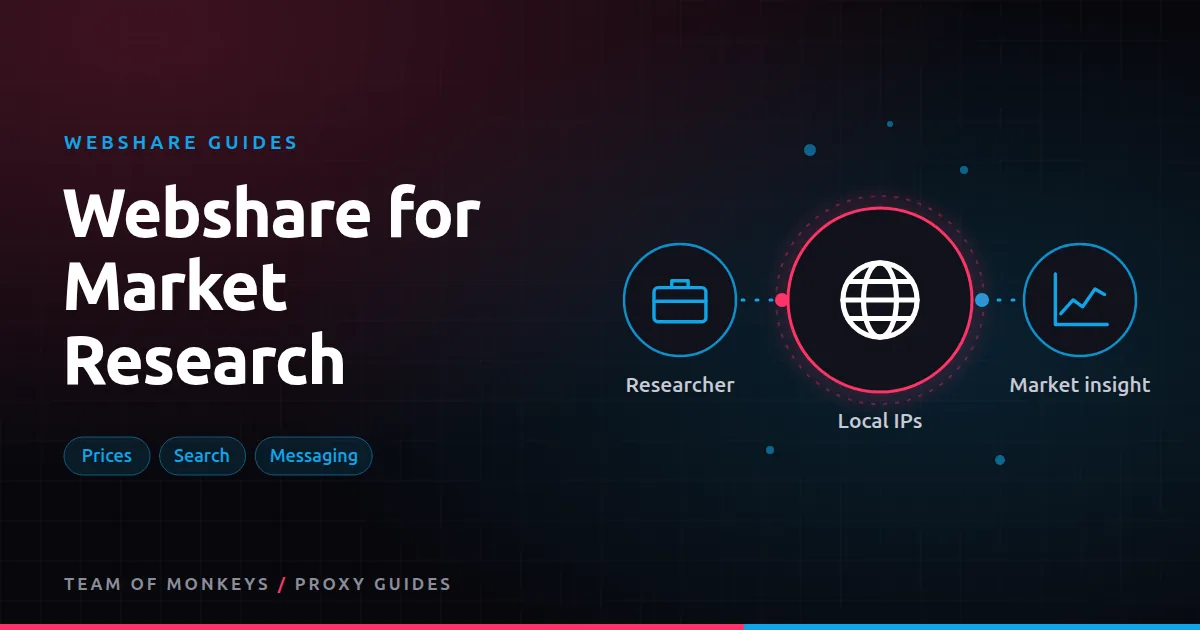
Websites localise heavily: prices, products, promotions, language, search results and ads all change by country, and often by city. If you research a market from your own office, you see your own market. Proxies let you see each market as a local visitor would. Background in market research proxies.
What you can research
- Pricing and promotions of competitors in each market.
- Assortment: which products are offered where.
- Messaging: landing pages, positioning and offers by region.
- Search demand signals: what ranks and what ads appear for key terms.
- Online conversation: forums, reviews and local news.
Which Webshare product
| Research task | Webshare product |
|---|---|
| Local search results and ads | Rotating residential, country or city targeted |
| Competitor sites (mostly lenient) | Datacenter list in the target country |
| Large retailers and marketplaces | Rotating residential |
| Manual browsing of a market | Chrome extension with a country-specific proxy |
Webshare's residential network covers 195 countries, and datacenter lists can be bought in 50+ countries. See Webshare geo-targeting.
Methods that hold up
- Match the whole context. IP location, browser language, currency and timezone together. A local IP with an English browser can still show you an international site.
- Repeat over time. One snapshot can mislead; prices and promotions change daily.
- Sample several IPs per market and compare. Personalisation and A/B tests cause variation.
- Record evidence: dates, URLs, screenshots and the IP location used.
- Separate logged-in and logged-out views. Logged-in experiences differ by account history.
Manual vs automated
Small studies can be done by hand with the Chrome extension and a few country proxies. Ongoing tracking (weekly price baskets, monthly assortment reviews) is better automated with scripts or no-code tools; see Webshare in automation tools.
Budget tip: You can test most of this guide for free: Webshare gives every new account 10 datacenter proxies and 1 GB of bandwidth a month without a credit card. Move to a paid plan once the pilot works. See our complete Webshare guide.
Ethics and compliance
Collect public information, respect site terms and rate limits, and handle any personal data (such as review authors) carefully. See ethical web scraping.
Comparing providers
For research projects that run in bursts, non-expiring residential bandwidth can be more economical than monthly plans. Geonode offers that model; see Webshare vs Geonode for market research.
Designing a cross-market study
| Element | Example choice |
|---|---|
| Markets | US, UK, Germany, Brazil, Japan |
| Sites | Top 5 retailers and 3 competitors per market |
| Measures | Price of a 20-item basket, assortment depth, promotions |
| Frequency | Weekly for 8 weeks |
| IPs | Residential country targeting for retailers, datacenter for competitor sites |
| Evidence | Screenshots and saved HTML per measurement |
A clear design makes results comparable across markets and over time.
Avoiding biased results
- Use several IPs per market so one IP's personalisation doesn't skew the result.
- Clear cookies between measurements.
- Keep the browser configuration identical across markets except for locale settings.
- Note promotions and holidays that distort a week's data.
Turning data into insight
Present findings with context: currency-adjusted prices, assortment overlap, and promotion frequency. Flag gaps in coverage, such as a site that blocked collection one week, rather than silently dropping it.
Proxy tip: If your residential usage goes up and down, compare Geonode: its per-GB residential bandwidth doesn't expire, so you only pay for what you use. See Geonode for market research.
Low-code options
For small studies, spreadsheets plus a browser extension can be enough. For recurring studies, a simple Playwright script that saves screenshots and extracted values per market saves hours each week.
A real-world example
A consumer goods company considering entry into Mexico and Colombia asks its strategy team to compare local pricing for 30 comparable products. The team uses Webshare residential IPs in each country, sets browsers to local language and currency, and records prices weekly from the top retailers for two months. The resulting dataset shows a consistent price gap in one category, which shapes the launch plan.
If you're still shortlisting, compare this setup with the options in our best proxies guide, and use our cheap proxies guide to estimate what a sensible budget looks like.
Key takeaways
- Proxies let you see local prices, assortments, search results and messaging in other countries.
- Use residential IPs for search, ads and large retailers, and datacenter IPs for most competitor sites.
- Match IP location, language, currency and timezone for accurate results.
- Sample several IPs per market and repeat measurements over time.
- Record dates, locations and evidence for every observation.
FAQ
Can I research a country I'm not in with Webshare?
Yes. Choose proxies or residential targeting in that country and match your browser's language and timezone.
Do I need residential proxies for market research?
For search results, ads and large retailers, usually. For many competitor sites, datacenter IPs in the right country are enough.
How many countries can Webshare cover?
Its residential network covers 195 countries; datacenter lists cover 50+ at the time of writing.
Can I research markets in languages I don't speak?
Yes; collect data with local settings, then translate it. Keep original text for accuracy.
How long should a market study run?
Long enough to see normal variation, often four to eight weeks for prices and promotions.
Should I log into local accounts during research?
Usually not; logged-out views are more neutral and avoid account risk.
Editorial note: Proxy providers change their pools, features and prices often, so treat any figures here as typical ranges at the time of writing and confirm current terms with the provider before you buy.