Why sourcing is a real question
A residential proxy is someone's home or phone connection. For that IP to be in a provider's pool, someone's device has to be running software that routes other people's traffic. The ethical question is whether that person knows and agreed. Historically, some pools were built from apps that buried consent in long terms or from malware. Using such a pool exposes you to reputational and legal risk, and it's unfair to the people whose connections are used. Our guides to how proxy providers source IPs and ethically sourced proxies go into the background.
What Rayobyte says it does
Rayobyte has made ethics a central part of its brand. At the time of writing, it states that:
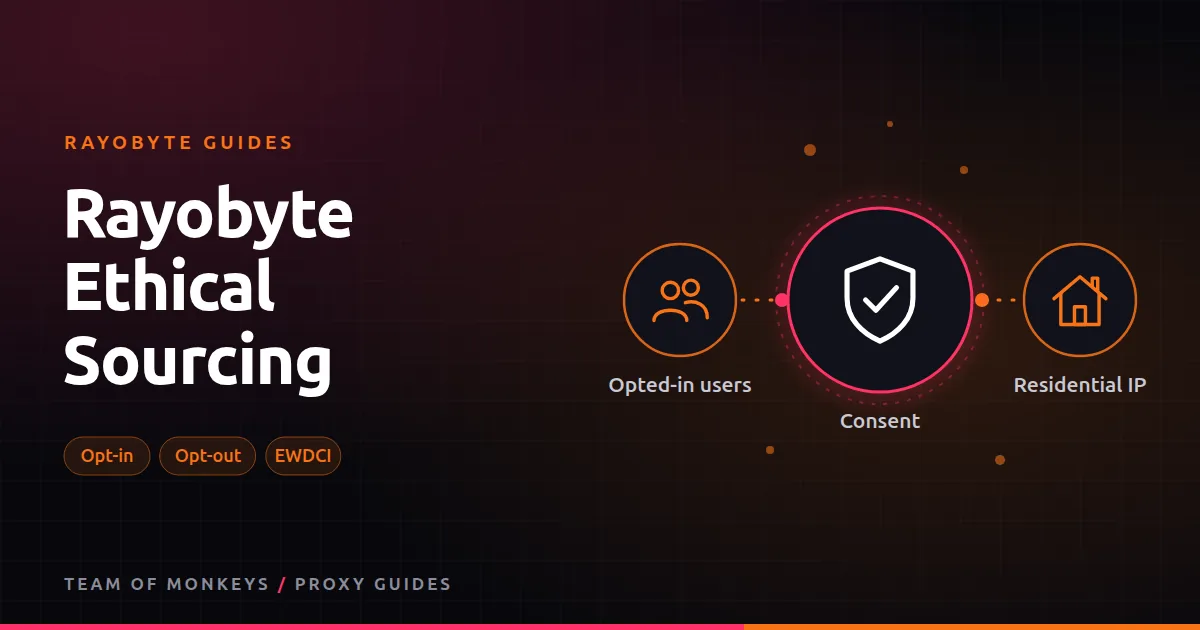
- IPs come from people who opted in through an app, after a consent screen.
- Users can opt out at any time through a visible opt-out.
- It owns its residential network rather than reselling another provider's.
- Risky targets are blocked for everyone: banks, government sites, login pages and sites that report abuse.
- Unusual use triggers ID checks.
- It knows every paying customer and acts on abuse reports within one business day.
- It is EWDCI certified (the Ethical Web Data Collection Initiative) and GDPR and CCPA compliant.
What those commitments mean in practice
Consent screens mean the device owner saw a clear explanation, not just a line in the terms. Visible opt-out means they can stop at any time without uninstalling an app. Together, they're the minimum standard ethical sourcing advocates ask for.
Blocking banks, government sites and login pages removes the most common abuse paths, such as credential stuffing and account takeover, from the residential network. That's also why legitimate account work should use static ISP IPs instead.
Customer vetting (ID checks on unusual use and a compliance review for Scale Residential) keeps bad actors off the network. That benefits you directly: a pool used by fraudsters gets IPs flagged faster.
Residential tip: Before scaling, run a short pilot with Rayobyte on your real targets and record success rate, latency and GB per result. Our Rayobyte Premium Residential proxies explains which Rayobyte product fits which job.
Why it matters to you as a buyer
- Cleaner IPs. Pools with fewer abusive users get blocked less.
- Less legal exposure. If your work is ever examined, using a provider with documented consent and compliance is easier to defend.
- Corporate procurement. Larger companies increasingly require evidence of ethical sourcing in vendor reviews. A certification and published policy shorten that process.
- Stability. Networks built on consent tend to keep their users, which means a steadier pool.
The trade-offs
Ethical controls do add friction:
- Some targets are off limits on residential, even for legitimate reasons. See compliance review and restricted sites.
- High-volume products need a review.
- You may be asked for ID if usage looks unusual.
For most scraping, SEO, ad verification and research, none of this gets in the way.
Questions to ask any provider
Whatever you buy, ask:
- How do residential users consent, and can they opt out easily?
- Do you own the network or resell it?
- Which targets do you block?
- How do you vet customers and handle abuse reports?
- Which certifications or audits can you share?
Proxy tip: If your residential usage goes up and down, compare Geonode: its per-GB residential bandwidth doesn't expire, so you only pay for what you use. See Rayobyte vs Geonode.
How it compares
Geonode and Webshare also publish sourcing statements; the detail and certifications differ. We compare what each says in Rayobyte vs Geonode ethics and sourcing, Rayobyte vs Webshare ethics and sourcing and all three compared. For the legal side generally, see are proxies legal.
If you're still shortlisting, compare these options with the wider market in our best proxies guide, and use our cheap proxies guide to estimate a sensible budget. To understand the IP type behind this, read our residential proxies guide.
Budget tip: If you want a cheap proxy to try this with, Webshare has a free plan with 10 datacenter proxies and 1 GB of bandwidth a month, no card required. Paid lists let you pick proxy count, bandwidth and location. See Webshare for academic research.
Key takeaways
- Rayobyte says its residential IPs come from opted-in users with a visible opt-out, on a network it owns.
- Banks, government sites, login pages and abuse-reporting sites are blocked on residential.
- Customer vetting and EWDCI certification support its ethics claims.
- Ethical sourcing means cleaner IPs and easier compliance, with some friction.
FAQ
Is Rayobyte ethically sourced?
Rayobyte states that its residential IPs are opted in with consent and a visible opt-out, and it is EWDCI certified. As with any provider, review its published policies yourself.
Why can't I access login pages through Rayobyte residential proxies?
Login pages are on the blocked list to prevent account takeover and credential stuffing on the residential network.
What is the EWDCI?
The Ethical Web Data Collection Initiative is an industry group that sets standards for responsible web data collection, including proxy sourcing.
Editorial note: Proxy providers change their pools, features and prices often, so treat any figures here as typical ranges at the time of writing and confirm current terms with the provider before you buy.