What Premium Residential is
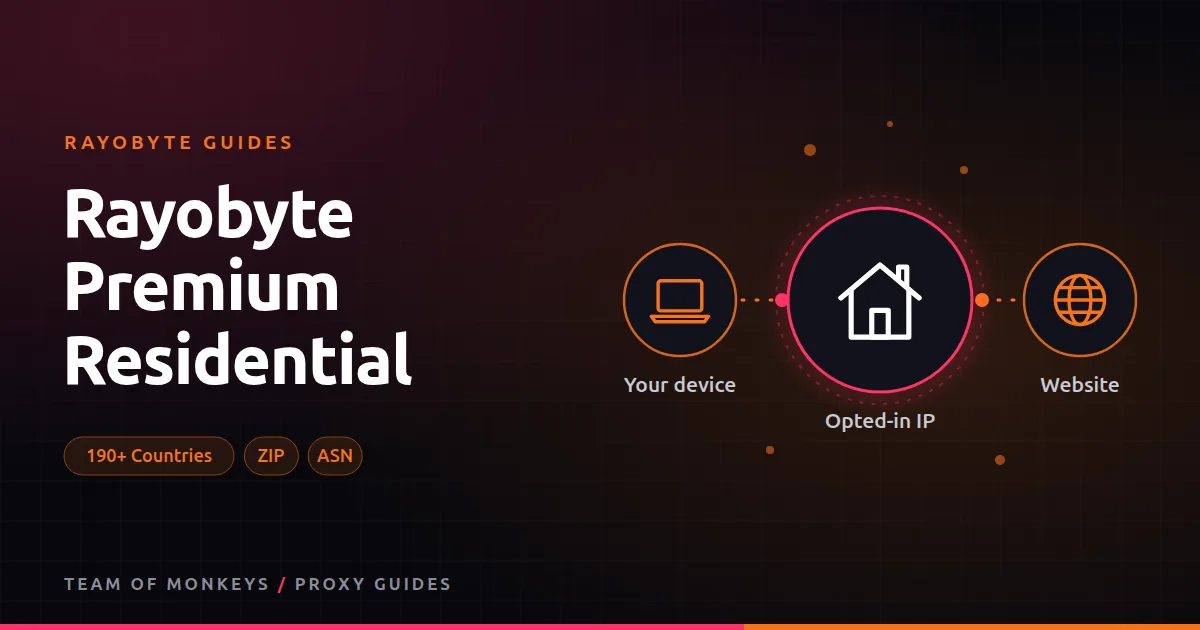
Premium Residential is Rayobyte's main residential product and the one most buyers mean when they say "Rayobyte residential proxies". You connect to a gateway, and each request exits through an IP address on a real home internet connection. Websites see an ordinary household visitor rather than a server, which is why residential IPs get through where datacenter IPs are blocked. If you're new to the idea, our residential proxies guide explains the basics.
The pool
Rayobyte says its residential network reaches more than 50 million opted-in devices every month across 190+ countries, and that it owns the network rather than reselling someone else's. The IPs come from people who agreed to share bandwidth through an app consent screen and can opt out at any time. We look at this in detail in how Rayobyte sources residential IPs.
Pool size figures aren't directly comparable between providers, because some count IPs seen per month and others count total IPs. What matters more is whether the pool is deep in the locations you target, so test your own countries and cities.
Targeting options
Premium Residential lets you narrow the exit IP by:
- Country, across 190+ locations.
- State and city.
- ZIP code, for hyperlocal checks such as local search results or delivery availability.
- ASN, meaning a specific internet provider, useful when a site treats carriers differently.
- Device operating system, which few providers offer and which helps when a site serves different content to different platforms.
The narrower the target, the smaller the available pool, so use the broadest setting that still gives correct results. See Rayobyte geo-targeting for examples.
Rotation and sticky sessions
You can rotate to a new IP on every request or hold a sticky session for 1 to 120 minutes. Rayobyte is upfront that a residential IP can still drop before the session ends, because the device behind it may go offline, so scrapers should retry with a new session when that happens. Our guide to Rayobyte sticky sessions covers session design.
Residential tip: You can test most of this guide for free: Rayobyte offers a no-card trial on Premium Residential, rotating ISP and rotating datacenter proxies. Move to a paid plan once the pilot works. See our complete Rayobyte guide.
Protocols
Premium Residential supports HTTP, HTTPS, SOCKS5, SOCKS5 with UDP, and HTTP/3. UDP and HTTP/3 support are rarer than you'd expect, and they matter for some apps, games and modern sites. See SOCKS5, UDP and protocol support and HTTP/3 proxies.
Pricing
| Purchase size | Price per GB |
|---|---|
| 1 to 49 GB | $3.50 |
| 50 to 249 GB | $2.00 |
| 250 to 999 GB | $1.50 |
| 1,000 to 4,999 GB | $0.70 |
| Enterprise | From $0.50 |
Prices are list prices at the time of writing. Concurrency is listed as unlimited on Premium Residential. There's a free trial with no card, covered in the Rayobyte free trial. For the full billing picture, see Rayobyte pricing explained.
Safety rules that apply
Rayobyte blocks some target categories on its residential network for every customer: banks, government sites, login pages and sites that report abuse. Unusual usage can trigger an ID check. Most scraping, SEO and ad verification work is unaffected, but if your project touches logins, read compliance review and restricted sites first.
When Premium Residential is the right choice
- Protected sites that block datacenter IPs on sight.
- Local results where country, city or ZIP accuracy matters, such as SEO rank tracking and ad verification.
- Moderate volumes where pay-as-you-go flexibility beats a monthly commitment.
Proxy tip: For a second opinion on hard targets, run the same test through Geonode residential proxies, which support sticky sessions up to 24 hours and ASN targeting. We compare the two in Rayobyte vs Geonode.
When something else is better
- Very large untargeted crawls: Scale Residential costs a fraction of the price per GB.
- Lenient sites: rotating datacenter is roughly ten times cheaper.
- One IP per account for weeks: static ISP IPs never change.
- Hard sites where you'd rather not tune anything: the Web Unblocker.
How it compares
Geonode lists lower per-GB prices at small volumes and allows sticky sessions up to 24 hours, while Rayobyte offers ZIP, OS targeting, SOCKS5 UDP and HTTP/3. Webshare's residential is sold on monthly plans with similar ZIP and ASN targeting. See Rayobyte vs Geonode residential proxies and Rayobyte vs Webshare residential proxies.
If you're still shortlisting, compare these options with the wider market in our best proxies guide, and use our cheap proxies guide to estimate a sensible budget.
Budget tip: For jobs where a fixed IP list is enough, Webshare is one of the cheapest options: shared datacenter proxies are sold by the IP, and static residential (ISP) proxies cost well under a dollar per IP per month at the time of writing. More in Webshare rotating residential proxies.
Key takeaways
- Premium Residential is Rayobyte's flexible, fully targetable residential product.
- Targeting goes down to ZIP, ASN and device OS; sessions last up to 120 minutes.
- Pricing falls from $3.50 to $0.70 per GB with purchase size.
- Use cheaper products for lenient or untargeted work.
FAQ
Does Premium Residential bandwidth expire?
The pricing page doesn't state an expiry for pay-as-you-go traffic at the time of writing, and past reviews described it as non-expiring. Confirm in the dashboard or with support before buying a large amount.
Can I use Premium Residential for logins?
Login pages are on Rayobyte's blocked list for residential traffic. For account work, static ISP proxies are the usual choice.
How many concurrent connections can I run?
Rayobyte lists concurrency as unlimited on Premium Residential, though your own code and the target's rate limits will set the practical ceiling.
Editorial note: Proxy providers change their pools, features and prices often, so treat any figures here as typical ranges at the time of writing and confirm current terms with the provider before you buy.