What you get
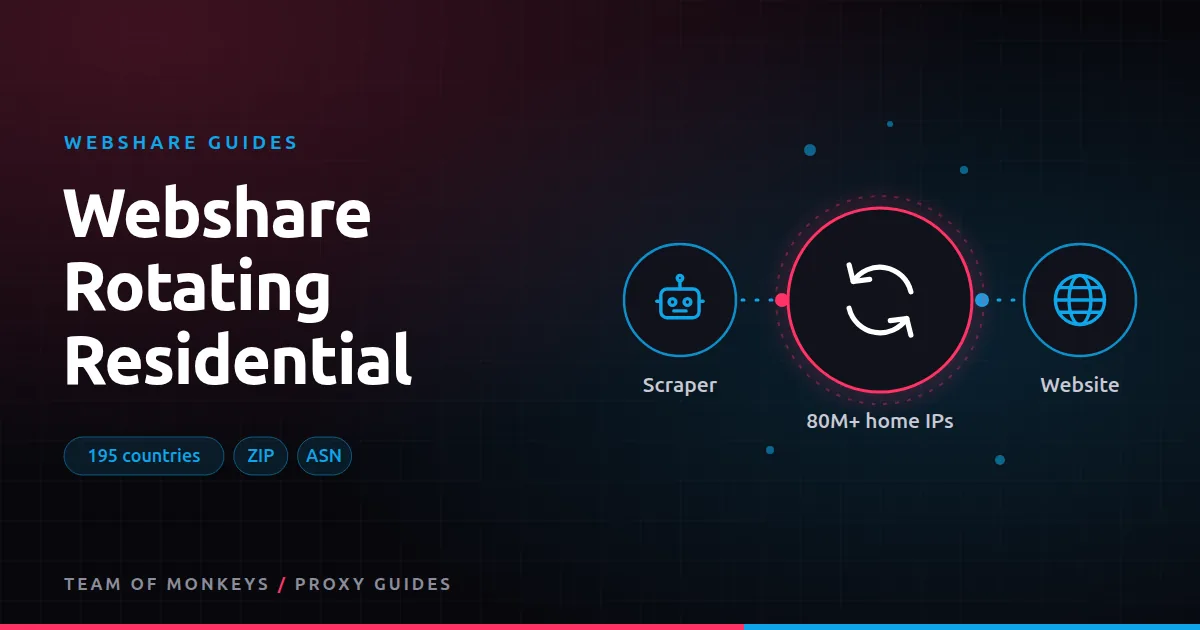
Webshare's rotating residential product gives you access to a large pool of IP addresses that belong to real home internet connections. Instead of a fixed list, you connect to a gateway and Webshare assigns an exit IP from the pool. Because the IPs look like ordinary households to websites, they pass checks that datacenter IPs fail. For the general concept, see rotating residential proxies.
Key facts at the time of writing:
| Feature | Webshare rotating residential |
|---|---|
| Pool size | 80M+ residential IPs (Webshare's figure) |
| Countries | 195 |
| Targeting | Country, state, city, ZIP and ASN |
| Sessions | Rotate per request, or hold a session |
| Protocols | HTTP and SOCKS5 |
| Authentication | Username and password (gateway), IP authorization |
| Pricing | Per GB on monthly plans, $3.50 per GB at 1 GB to $1.40 per GB at 3,000 GB |
| Sourcing | Described by Webshare as ethically sourced from compliant partners |
How rotation works
You connect to Webshare's gateway (the backbone endpoint) with your residential credentials. What happens next depends on the username suffix:
- Rotate. A rotate suffix tells the gateway to use a new IP for every request. This is the default choice for scraping many independent pages.
- Session. A session number keeps the same exit IP for requests that share that number. Use it for logins, carts and pagination. See Webshare sticky sessions.
Residential IPs can drop off when a household device disconnects, so even sticky sessions don't last forever. Build retries into anything that depends on a session.
Targeting
Residential targeting is one of Webshare's strengths. You can narrow the pool to a country, then to a state, city or ZIP code, or target by ASN (a specific internet provider). Targeting is set in the username or through the dashboard's endpoint generator; our Webshare geo-targeting guide shows the patterns.
A rule of thumb: target only as narrowly as the job needs. A city pool is smaller than a country pool, which means fewer IPs to rotate through and sometimes slower connections.
Pricing and plan sizing
Residential plans are monthly and priced per GB, with lower rates at larger sizes. At list price, a 10 GB month costs roughly $25 to $35 and a 100 GB month a little over $200, with yearly billing and promotions lowering that. Full figures in Webshare pricing explained.
Because plans are monthly, size them to your real usage. Measure GB per 1,000 pages on the free plan or a small residential plan first, then multiply. Blocking images, fonts and video in headless browsers can cut residential bandwidth by half or more.
What it's good for
- Scraping protected sites that block datacenter IPs. See Webshare for web scraping.
- Local results. Search rankings, prices and ads as seen from specific cities. See SEO rank tracking and ad verification.
- E-commerce and travel data where prices change by location. See e-commerce scraping and travel fares.
- Raffle entries and other jobs that need many distinct, trusted IPs.
Restricted targets
Like most residential providers, Webshare restricts some categories of websites on its residential network to prevent abuse of the people whose connections make up the pool. Some restrictions can be lifted after a KYC (know your customer) check. If a target returns a provider-side error rather than a site block, check Webshare restricted sites and KYC.
Budget tip: You can test most of this guide for free: Webshare gives every new account 10 datacenter proxies and 1 GB of bandwidth a month without a credit card. Move to a paid plan once the pilot works. See our complete Webshare guide.
Setup example
A minimal Python example using the gateway (replace the placeholders with values from your dashboard):
import requests

proxy = "http://USERNAME-rotate:PASSWORD@p.webshare.io:80"
r = requests.get("https://httpbin.org/ip", proxies={"http": proxy, "https": proxy}, timeout=30)
print(r.json())
Run it a few times; with the rotate suffix, the IP should change on each request. More in Webshare with Python.
How it compares
Webshare's residential network is large and finely targetable, but its per-GB list prices are higher than some competitors at small volumes, and monthly plans need sizing. Geonode, for comparison, lists residential bandwidth below $1 per GB with no expiry and sticky sessions up to 24 hours. We compare the two in detail in Webshare vs Geonode residential proxies.
Estimating your monthly GB
Residential traffic is billed per GB, so a quick estimate avoids buying the wrong plan:
Monthly GB = pages per month x KB per page / 1,000,000 / success rate
| Job | Pages per month | KB per page | Success rate | Monthly GB |
|---|---|---|---|---|
| HTML scraping of a marketplace | 200,000 | 300 | 90% | About 67 |
| SERP checks | 50,000 | 250 | 85% | About 15 |
| Headless browser with images blocked | 20,000 | 1,200 | 90% | About 27 |
| Headless browser, full loads | 20,000 | 3,500 | 90% | About 78 |
Measure your own KB per page on a small plan, then pick the plan size just above your estimate.
Getting better success rates
- Use sessions for multi-step flows so cookies and IP stay together.
- Match the browser locale and timezone to the targeted country.
- Slow down per domain. Residential IPs are trusted, but bursts still trigger defences.
- Target broadly unless the job needs a specific city; bigger pools mean fresher IPs.
- Retry with a new IP, not the same one, and cap retries.
Proxy tip: If your residential usage goes up and down, compare Geonode: its per-GB residential bandwidth doesn't expire, so you only pay for what you use. See Webshare vs Geonode.
Residential and datacenter together
The most cost-effective setups route each target to the cheapest proxy type that works. Keep a list of "residential-only" domains, send everything else through a datacenter list, and review the list monthly. Some sites relax their defences; others tighten them. Webshare makes this easy because both products live in one account and use the same credentials format.
When to look elsewhere
If residential becomes most of your spend, your usage is seasonal, or you need sessions longer than a short flow, compare a provider built around per-GB residential. Geonode, for instance, lists lower per-GB prices with no expiry. See Webshare vs Geonode pricing.
A real-world example
An SEO consultancy tracks 800 keywords in five US cities. Datacenter IPs hit CAPTCHAs on the search engine, so they switch to Webshare rotating residential traffic with city targeting. Each SERP is about 250 KB as HTML, and with an 88% first-try success rate the program uses around 35 GB a month. They size the plan to that, match browser language and location parameters to each city, and retry failed queries with fresh IPs, which keeps the rankings consistent day to day.
Before you commit to any provider, it helps to see the wider market: our guide to the best proxies in 2026 compares proxy types by job, and cheap proxies explains how to keep costs down without buying IPs that get blocked. To understand the IP type behind this, read our residential proxies guide.
Key takeaways
- Webshare's rotating residential network advertises 80M+ IPs in 195 countries, with country, state, city, ZIP and ASN targeting.
- Use the rotate option for independent pages and a session number for multi-step flows.
- Plans are monthly and priced per GB, so estimate GB from page size, volume and success rate before buying.
- Some targets are restricted on residential traffic and may be unlocked after KYC.
- Reserve residential for targets that block datacenter IPs, and block heavy resources to save bandwidth.
FAQ
Is Webshare residential the same as static residential?
No. Rotating residential uses a large pool of changing home IPs billed per GB. Static residential uses fixed ISP IPs billed per IP. See Webshare static residential proxies.
Can I choose the city with Webshare residential proxies?
Yes. Webshare supports country, state, city, ZIP and ASN targeting on its residential network.
Does Webshare residential bandwidth roll over?
Residential plans are monthly, and third-party reviews report that unused bandwidth resets each cycle. Check the current terms at checkout before buying a large plan.
How large is Webshare's residential pool?
Webshare advertises 80M+ residential IPs across 195 countries at the time of writing.
Does Webshare residential support SOCKS5?
Yes, along with HTTP.
Can I target a specific ISP with Webshare residential?
Yes. ASN targeting lets you choose a specific internet provider's network.
Editorial note: Proxy providers change their pools, features and prices often, so treat any figures here as typical ranges at the time of writing and confirm current terms with the provider before you buy.