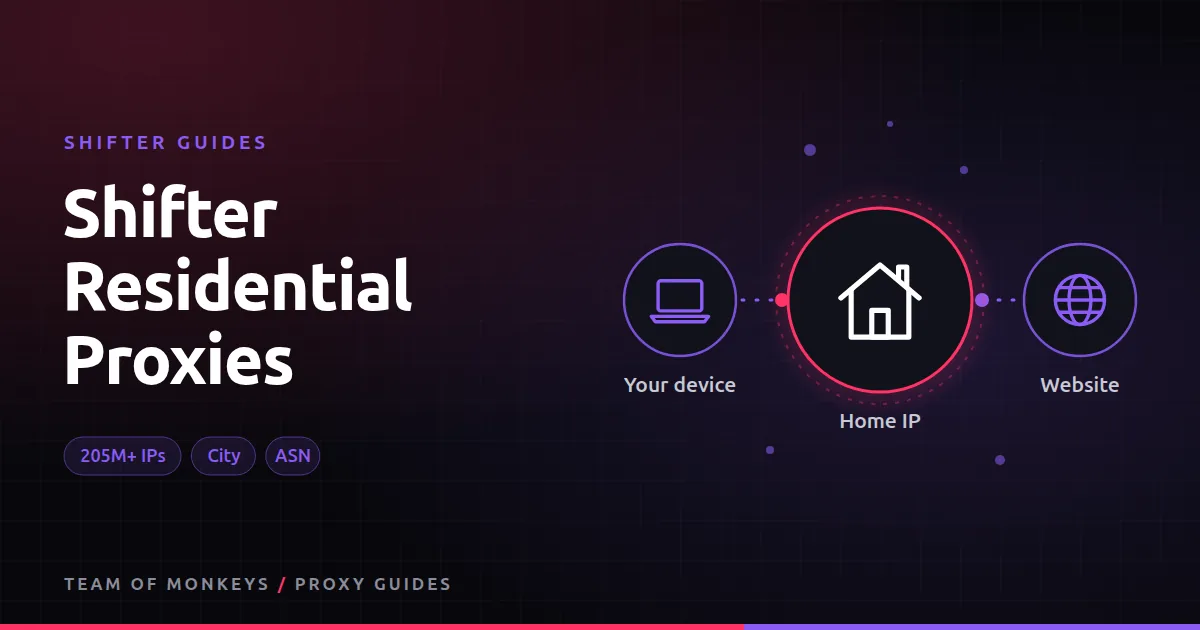
Shifter's residential proxies route your requests through IP addresses that consumer internet providers assign to real home connections. Shifter says these come from devices whose owners opt in through a consent-based SDK. They are the right tool when a target blocks datacenter IPs. For background, see our residential proxies guide.
Three pools, one account
| Full Geo | Country Geo | Non-Geo | |
|---|---|---|---|
| IPs (provider figure) | 205M+ | 31M+ | 31M+ |
| Targeting | Country, state, city, ASN | Country | None |
| Price from | $0.75/GB | $0.48/GB | $0.10/GB |
| Best for | Local results, ads, accounts | Country-level data | Bulk crawling |
All three use the same dashboard, credentials and API, so you can send each job to the cheapest pool that still works.
Targeting
Targeting goes in the username. A Full Geo request for the United States with a sticky session looks like customer-USERNAME-country-us-sid-123ABC. You can narrow it to a state, a city or an ASN, which is useful for checking local search results or ads. City and ASN targeting work only on the Full Geo pool.
Rotation and sticky sessions
- Per request (default): every request gets a new IP. Best for scraping many independent pages.
- Sticky: add a
sidvalue to keep the same IP across requests, for logins, carts and pagination. - Timed: add a
ttlvalue to set how long a session lasts. Shifter's homepage mentions sessions of up to 60 minutes, and its FAQ gives a default of 120 seconds.
See sticky vs rotating sessions for when to use each.
Shifter tip: The cheapest real test is Shifter's smallest residential plan, 5 GB for $10, inside the 3-day money-back window. See every Shifter guide and comparison.
Protocols, concurrency and speed
Every plan supports HTTP(S) and SOCKS5 on p.shifter.io:443. Shifter puts no cap on concurrent connections, which matters for large crawls. It quotes a 99.9% success rate and responses under 500 ms; treat those as vendor figures and measure them on your own targets.
Prices
Full Geo plans start at $10 for 5 GB and fall to $0.75 per GB from 200 GB a month. Full tables are in Shifter pricing explained.
Coupon tip: If you want a private IP rather than a shared pool, Proxy Seller rents dedicated IPv4 proxies from $0.49 per IP for as little as a week. Code MONKEYS takes 15% off. See Proxy Seller residential proxies.
Which pool to pick
- Need city or ISP accuracy? Full Geo.
- Need the right country only? Country Geo, at about two thirds of the Full Geo price.
- Location doesn't matter? Non-Geo, at a fraction of the cost. Test success rates first, since a smaller pool may hit blocks sooner on strict targets.
Still deciding? Compare the market in best proxies in 2026, find working discounts on our proxy coupons page, and follow our buy proxies checklist before you pay.
Proxy tip: A good way to compare providers is to run the same test plan on each. Geonode makes that cheap to do because you can buy a small amount of residential bandwidth and use it at your own pace. See our complete Geonode guide.
Key takeaways
- Full Geo has 205M+ IPs with city and ASN targeting; the other pools trade targeting for price.
- Rotation is per request by default; use
sidandttlfor sessions. - Unlimited concurrency and SOCKS5 on every plan.
FAQ
How many IPs does Shifter have?
Shifter lists 205M+ residential IPs on its Full Geo pool and 31M+ on the Country Geo and Non-Geo pools.
Can I target a city with Shifter?
Yes, on the Full Geo pool, along with country, state and ASN.
Sources and further reading
Independent references that back up the points above, from standards bodies, governments, universities and non-profits. They open in a new tab.
- Number Resources (IANA): How IANA hands IP address blocks to the regional internet registries.
- RFC 1928: SOCKS Protocol Version 5 (IETF / RFC Editor): The original specification of SOCKS5, including UDP support and authentication negotiation.
- RFC 9110: HTTP Semantics (IETF / RFC Editor): The HTTP standard that defines how proxies, tunnels and the CONNECT method behave.
- SOCKS (Wikipedia): Encyclopedia overview of the SOCKS protocol family.
- Internet Engineering Task Force (IETF): The body that publishes the internet standards proxies are built on.
Editorial note: Proxy providers change their pools, features and prices often, so treat any figures here as typical ranges at the time of writing and confirm current terms with the provider before you buy.