What a web unblocker is
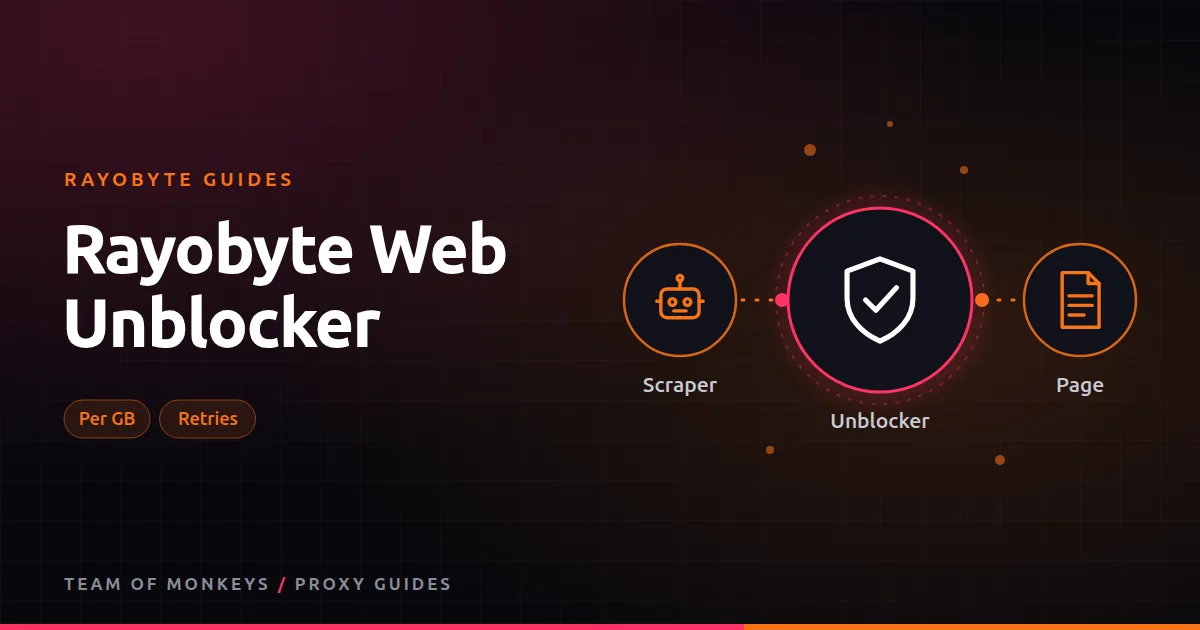
A web unblocker looks like a proxy to your code: you set a host and port, and send requests. Behind the endpoint, the provider does much more than forward traffic. It chooses IPs, manages headers and fingerprints, retries blocked attempts and handles challenges, then hands you the successful response. Our general guide to web unblocker proxies explains the category.
Rayobyte's Web Unblocker works this way. You use it as a proxy host and port from any HTTP client, and it returns the page as HTML.
Pricing
At the time of writing:
| Successful traffic | Price per GB |
|---|---|
| Up to 10 GB | $6.00 |
| Falling with volume | Tiered |
| 501 to 1,000 GB | $2.50 |
| Over 1,000 GB | Custom plan |
You pay per GB of successful traffic, so failed attempts and retries aren't billed. There's a free trial.
Web Unblocker vs Premium Residential
| Web Unblocker | Premium Residential | |
|---|---|---|
| What you get | Successful responses | Residential IPs |
| Block handling | Done for you | Your code |
| Billing | Per GB of successful traffic | Per GB of all traffic |
| Price at small volume | $6 per GB | $3.50 per GB |
| Control | Less | Full |
The unblocker costs more per GB, but that comparison is misleading if your residential success rate is low. If half your residential requests fail, you're effectively paying $7 per GB of useful data, plus the time spent retrying. On hard sites, the unblocker can be cheaper per result.
Residential tip: Before scaling, run a short pilot with Rayobyte on your real targets and record success rate, latency and GB per result. Our our complete Rayobyte guide explains which Rayobyte product fits which job.
Web Unblocker vs the Scraping API
Both are managed. The difference is the interface and the billing:
- The Web Unblocker is a proxy endpoint. Your existing scraper code barely changes; you swap the proxy address. Billed per GB.
- The Scraping API is an API call per URL. Billed per successful request.
Per GB pricing suits light pages; per request pricing suits heavy pages. A 2 MB page costs about $0.012 through the unblocker at $6 per GB, against $0.0018 through the API. A 50 KB page costs about $0.0003 through the unblocker. Run the numbers on your own page sizes.
When to use it
- Hard targets where your own residential setup has low or unstable success rates. See avoiding IP bans when scraping.
- Teams that don't want to maintain unblocking logic but have a working scraper.
- CAPTCHA-heavy sites. See CAPTCHAs and proxies.
- E-commerce and travel sites with strong bot protection. See Rayobyte for e-commerce scraping.
When not to
- Lenient targets, where datacenter or residential proxies already work for a fraction of the price.
- Logged-in sessions with complex state, where you need control over every request.
- Non-HTML traffic, such as downloads or streaming.
Proxy tip: If your residential usage goes up and down, compare Geonode: its per-GB residential bandwidth doesn't expire, so you only pay for what you use. See the Geonode Scraper API.
Setting it up
- Start the free trial and open the Web Unblocker section of the dashboard.
- Copy the host, port and credentials.
- Set them as your HTTP client's proxy, exactly as you would a normal proxy. Because the unblocker inspects traffic, follow Rayobyte's docs for HTTPS certificate handling.
- Send a small batch to your hardest domain and compare success rate and cost per page with your current setup.
Code patterns are in our Python and Node.js guides; the only change is the proxy URL.
Rayobyte, Geonode and Webshare are three options among many. Our best proxies in 2026 guide explains how to match a proxy type to each task, and cheap proxies that work shows where budget providers fit.
Budget tip: If you want a cheap proxy to try this with, Webshare has a free plan with 10 datacenter proxies and 1 GB of bandwidth a month, no card required. Paid lists let you pick proxy count, bandwidth and location. See Rayobyte vs Webshare.
Key takeaways
- The Web Unblocker is a proxy endpoint that handles blocks and returns successful responses.
- $6 per GB of successful traffic at small volume, falling to $2.50 at 501 to 1,000 GB.
- Compare cost per successful page, not per GB, against your residential setup.
- Choose the Scraping API for heavy pages and the unblocker for light ones.
FAQ
Do I pay for blocked requests?
No. Billing is per GB of successful traffic.
Can I use it with Scrapy or Puppeteer?
Yes for HTTP clients like Scrapy, since it works as a normal proxy endpoint. For full browsers, check Rayobyte's docs; browsers usually pair better with rayobrowse or residential proxies. Our Puppeteer proxies guide covers the full setup.
Is there a free trial?
Yes, a free trial is listed at the time of writing.
Editorial note: Proxy providers change their pools, features and prices often, so treat any figures here as typical ranges at the time of writing and confirm current terms with the provider before you buy.