What static ISP proxies are
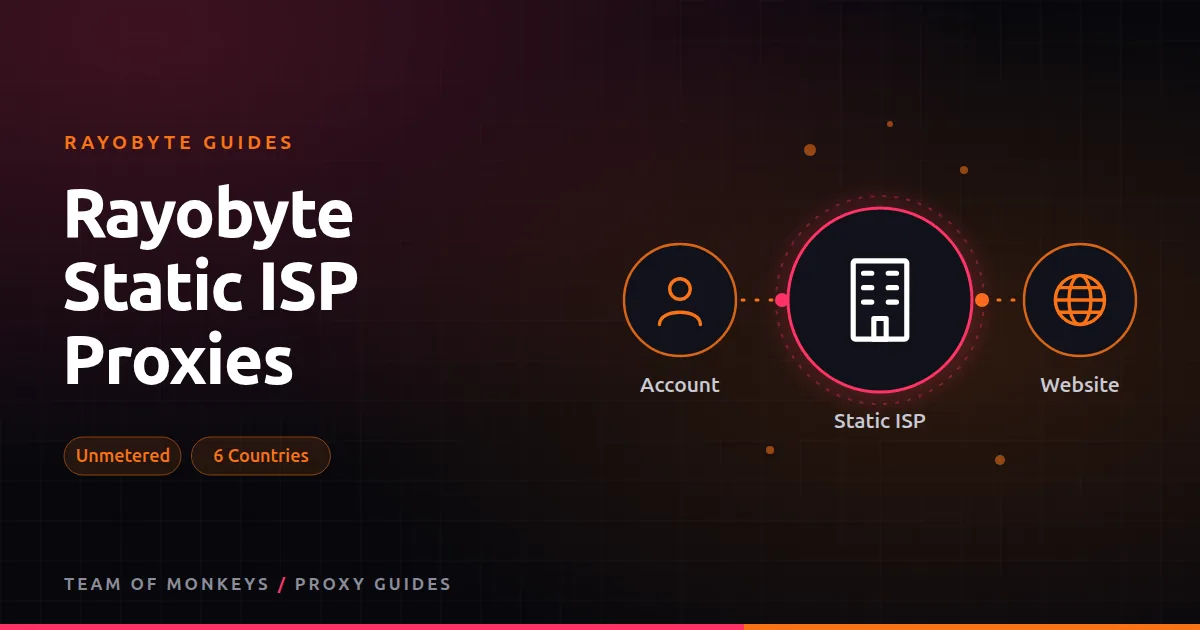
A static ISP proxy is an IP address registered to a consumer internet provider but hosted on a server in a data center. Websites see a home-ISP address, which carries more trust than a datacenter range, while you get the speed and stability of server hardware. Unlike residential IPs, the address doesn't change unless you ask for a new one. Our general guide to ISP proxies explains the type in depth.
Rayobyte describes its static ISP proxies as home-ISP IPs at "the speed of a datacenter connection", and sells them per IP per month.
Locations
At the time of writing, Rayobyte's static ISP IPs are available in six countries:
- United States
- United Kingdom
- Canada
- Germany
- France
- Italy
Semi-dedicated ISP IPs (shared with up to two other users) are offered in the US, UK, Canada and Germany on request. If you need ISP IPs elsewhere, ask sales or consider residential proxies with a sticky session.
Pricing
| IPs | Price per IP per month |
|---|---|
| 5 to 99 | $5.00 |
| 100 to 999 | $4.80 |
| 1,000 to 4,999 | $4.60 |
| Enterprise | From $0.95 with a commitment |
The minimum order is 5 IPs, and bandwidth is unlimited under a fair usage policy. That unmetered bandwidth is the big advantage over per-GB residential traffic for anything that streams a lot of data through one identity. See Rayobyte pricing explained.
Connection and authentication
Each IP works over HTTP, HTTPS and SOCKS. You can authenticate with a username and password on each proxy or by whitelisting your server IPs in the dashboard; both methods work on every IP. See Rayobyte authentication options.
Residential tip: Before scaling, run a short pilot with Rayobyte on your real targets and record success rate, latency and GB per result. Our our complete Rayobyte guide explains which Rayobyte product fits which job.
Replacing IPs
Static means the IP stays yours until you swap it. If an address gets flagged on a target, you can replace that one IP from the dashboard while keeping the rest of the list. That's useful for account work, where you want to change only the identity that's burned. See replacing Rayobyte IPs.
What they're good for
- Account management. One IP per social, marketplace or ad account, kept for months. See Rayobyte for social media management.
- Antidetect browser profiles. Pair each profile with one static IP. See Rayobyte with antidetect browsers.
- Sneaker checkout. Fast, stable sessions on release day. See Rayobyte for sneaker bots.
- Ad verification, SEO monitoring, brand protection and market research, which Rayobyte lists as core uses.
- Whitelisting. When a partner or API only accepts traffic from fixed addresses.
What they're not good for
- Mass scraping across many IPs. You'd need thousands of IPs; rotating ISP or residential is cheaper per request.
- Countries outside the six listed.
- Login flows on Rayobyte's residential network. That restriction applies to residential traffic; static ISP is the product Rayobyte points account users to, but always check the current terms.
Testing before you buy
Static ISP IPs aren't part of the self-serve free trial. To test them on your targets, contact sales for a few trial IPs, or buy the 5-IP minimum for a month, which costs $25 at list price. Run your real workflow, not just a speed test. Our testing Rayobyte proxies guide has a checklist.
Proxy tip: If your residential usage goes up and down, compare Geonode: its per-GB residential bandwidth doesn't expire, so you only pay for what you use. See Geonode ISP proxies.
How it compares
Webshare's static residential proxies are much cheaper per IP and come in more countries, while Geonode's ISP proxies start at $1.75 shared or $3.50 dedicated with a 3-IP minimum. Rayobyte's case rests on speed, unmetered bandwidth and IP quality rather than price. See Rayobyte vs Webshare ISP proxies, Rayobyte vs Geonode ISP proxies and all three compared.
Rayobyte, Geonode and Webshare are three options among many. Our best proxies in 2026 guide explains how to match a proxy type to each task, and cheap proxies that work shows where budget providers fit. To understand the IP type behind this, read our residential proxies guide.
Budget tip: If you want a cheap proxy to try this with, Webshare has a free plan with 10 datacenter proxies and 1 GB of bandwidth a month, no card required. Paid lists let you pick proxy count, bandwidth and location. See Webshare static residential proxies.
Key takeaways
- Rayobyte static ISP proxies are home-ISP IPs on fast servers, sold per IP with unmetered bandwidth.
- Six countries: US, UK, Canada, Germany, France and Italy.
- $5 per IP for small orders, falling to $4.60 at 1,000 IPs; 5-IP minimum.
- Best for accounts, long sessions, checkouts and whitelisting.
FAQ
Are Rayobyte ISP proxies residential?
They're registered to residential internet providers, so websites usually classify them as residential, but they're hosted on servers rather than in homes. That's why they're fast and stable.
Do Rayobyte static ISP IPs rotate?
No. They keep the same address until you replace them. For rotation, use rotating ISP proxies.
Is there a bandwidth limit?
Bandwidth is unlimited under a fair usage policy. Check section 13 of Rayobyte's terms for what counts as fair use.
Editorial note: Proxy providers change their pools, features and prices often, so treat any figures here as typical ranges at the time of writing and confirm current terms with the provider before you buy.