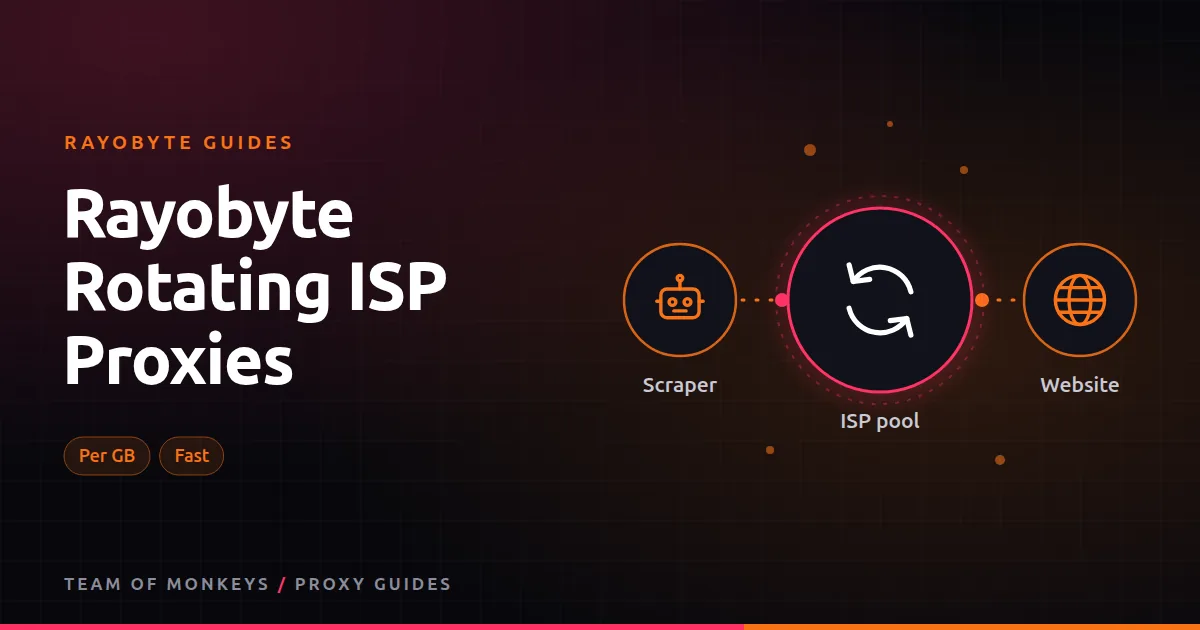
What rotating ISP proxies are
Rotating ISP proxies combine two ideas. Like static ISP proxies, the IPs are registered to consumer internet providers but run on fast server hardware. Unlike static ISP, you don't get a fixed list: you connect to a gateway and Rayobyte hands you a different ISP IP from its pool as you go. Rayobyte sums the product up as "home-ISP IPs at datacenter speed".
The result sits between residential and datacenter proxies. ISP IPs carry more trust than datacenter ranges, and because they live on servers they're faster and more stable than real household connections, which can drop when someone switches off their router. If you want the background, see ISP vs residential proxies.
Pricing
Rotating ISP is sold two ways at the time of writing.
Pay as you go (self-serve, with a free trial):
| Purchase size | Price per GB |
|---|---|
| 1 to 15 GB | $3.75 |
| 16 to 50 GB | $3.50 |
| 51 to 100 GB | $3.25 |
| 101 to 250 GB | $3.00 |
| 251 to 500 GB | $2.75 |
| 501 to 1,000 GB | $2.50 |
Monthly plans (through sales): $100 for 7,100 GB, $500 for 43,000 GB, $1,500 for 150,000 GB and $5,000 for 588,000 GB, which works out at roughly 0.85 to 1.4 cents per GB. Monthly plans support rotating or sticky sessions and allow one concurrent request per dollar of plan. See concurrency and threads.
The gap between the two is enormous. Pay as you go is for testing and modest volumes; once you know you'll move hundreds of GB a month, talk to sales about a monthly plan.
When rotating ISP beats residential
- Speed-sensitive scraping. Server-hosted IPs respond faster and more consistently than household connections.
- Sites that accept ISP ranges but block datacenter ranges, which covers many retailers and travel sites.
- High concurrency on a monthly plan, where the per-GB price is far below Premium Residential.
When residential is still better
- Precise geo-targeting. Premium Residential reaches 190+ countries with city, ZIP and ASN targeting; ISP coverage is narrower.
- The toughest anti-bot systems, which sometimes score real household IPs higher than ISP ranges.
- Diversity. A residential pool spans far more networks and devices.
Residential tip: Before scaling, run a short pilot with Rayobyte on your real targets and record success rate, latency and GB per result. Our Rayobyte static ISP proxies explains which Rayobyte product fits which job.
When datacenter is enough
If a target doesn't block datacenter IPs, rotating datacenter proxies at about $0.30 per GB cost a tenth as much. A sensible routing plan sends easy domains to datacenter, medium ones to rotating ISP and only the hardest to residential.
Setting it up
- Start the free trial and create a rotating ISP proxy user in the dashboard.
- Copy the gateway host, port and credentials from the connection page.
- Point your scraper at the gateway; each new connection gets a new IP.
- If you're on a monthly plan and need the same IP for a few steps, enable a sticky session as described in the dashboard documentation. See Rayobyte sticky sessions.
Code examples for every popular tool are in our guides to Python, Node.js and Scrapy.
Good fits
- Price monitoring on retailers with moderate protection.
- E-commerce scraping where speed matters at checkout-like pages.
- Travel fare collection, which mixes heavy pages with time pressure.
- SEO rank tracking at country level.
Proxy tip: If your residential usage goes up and down, compare Geonode: its per-GB residential bandwidth doesn't expire, so you only pay for what you use. See Geonode ISP proxies.
How it compares
At the time of writing, neither Geonode nor Webshare lists a pay-per-GB rotating ISP pool as a separate product. Geonode's ISP proxies and Webshare's static residential proxies are fixed lists you buy per IP (Webshare's backbone gateway can rotate across the IPs in your own list). If you want a large rotating pool of ISP-grade IPs billed per GB, Rayobyte is the one of our three partners that sells it. See ISP proxies compared across all three.
Not sure this is the right proxy type for the job? The best proxies in 2026 guide compares residential, ISP, datacenter and mobile options, and our cheap proxies guide covers budget picks that still work. To understand the IP type behind this, read our residential proxies guide.
Budget tip: If you want a cheap proxy to try this with, Webshare has a free plan with 10 datacenter proxies and 1 GB of bandwidth a month, no card required. Paid lists let you pick proxy count, bandwidth and location. See Webshare static residential proxies.
Key takeaways
- Rotating ISP gives you ISP-registered IPs from a pool, with the speed of server hosting.
- Pay as you go runs from $3.75 to $2.50 per GB; monthly plans cost around 1 cent per GB.
- Use it between datacenter (cheapest) and residential (most trusted).
- Monthly plans add sticky sessions and a concurrency cap of one request per dollar.
FAQ
Is rotating ISP the same as residential?
No. Residential IPs run on real home connections; rotating ISP IPs are registered to home ISPs but hosted on servers. Many sites treat both as residential, but the toughest may not.
Is there a free trial for rotating ISP?
Yes, the pay-as-you-go version is included in Rayobyte's self-serve free trial at the time of writing.
Which countries are covered?
Rayobyte doesn't list countries for rotating ISP on its pricing page. Check the dashboard or ask sales before committing if you need a specific location.
Editorial note: Proxy providers change their pools, features and prices often, so treat any figures here as typical ranges at the time of writing and confirm current terms with the provider before you buy.