The short answer
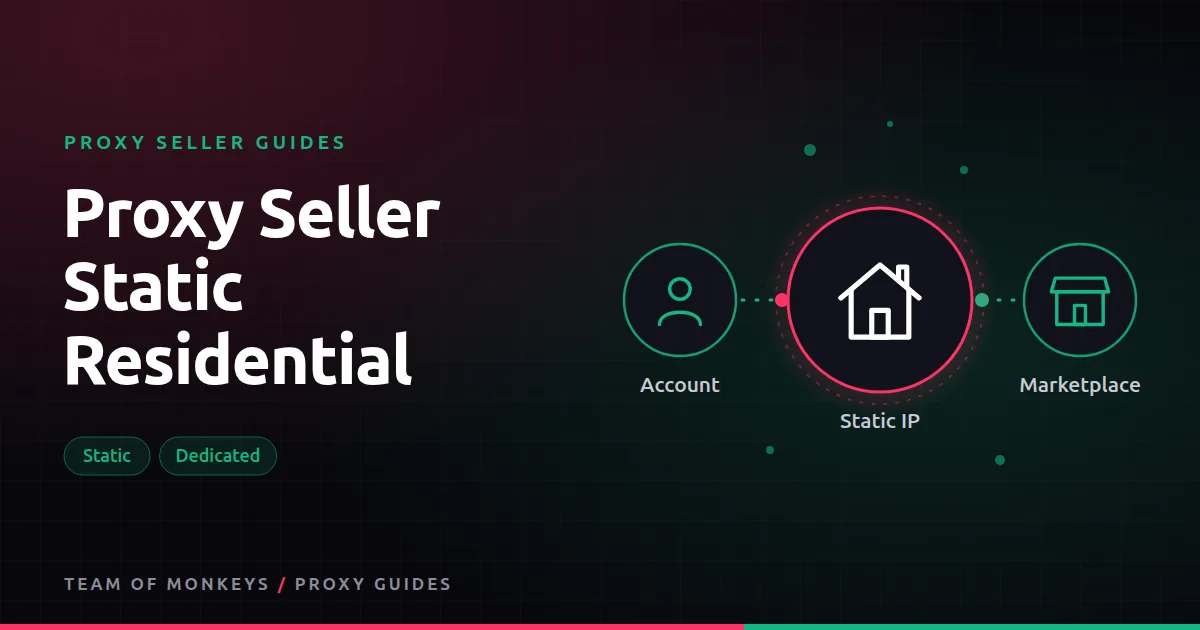
"Static residential" and "ISP proxy" usually describe the same thing: an IP registered to a consumer internet provider that stays fixed while you rent it. Proxy Seller sells both names. Its static residential page says it uses ISP-registered IPs, and the price, locations, subnet counts and fair use limits match the ISP product. So treat them as the same kind of proxy, and pick by the stock and price the order form shows you. Our ISP vs static residential quick answer covers the naming.
The facts
| Feature | Proxy Seller static residential |
|---|---|
| Price | From $0.98 per IP |
| Locations | US, UK, Germany, France, Japan |
| Subnets | 600+ Class C and 200+ Class B |
| Type | Dedicated per customer, static for the whole subscription |
| Rental periods | 1 week to 12 months |
| Protocols | HTTP, HTTPS, SOCKS5 |
| Authentication | IP allowlist or username and password |
| Bandwidth | Unlimited under fair use: 100 threads and 100 GB per IP by default |
| Volume | Up to 30% off on projects from 1,000 IPs |
Read on proxy-seller.com on 20 November 2026.

Coupon tip: Before you scale, buy a small order from Proxy Seller with code MONKEYS (15% off), test it on your real targets, and use the 24-hour refund or replacement window if it fails. See Proxy Seller ISP proxies.
Static residential vs rotating residential
| Static residential | Rotating residential | |
|---|---|---|
| IP | Same IP for the whole rental | Changes per request or on a timer |
| Billing | Per IP per period | Per GB |
| Best for | Accounts, long sessions, checkouts | Scraping many pages, broad geo coverage |
| Proxy Seller page | This one, and ISP proxies | Residential proxies |
If you scrape thousands of pages, use rotating residential. If you log into accounts, use static.
Good uses
- Social media accounts: one static IP per profile keeps logins consistent. See Proxy Seller for social media.
- E-commerce seller accounts and marketplace dashboards.
- Antidetect browsers: pair each browser profile with its own static IP. See antidetect browsers.
- Long sessions on sites that challenge IP changes.
Proxy tip: A good way to compare providers is to run the same test plan on each. Geonode makes that cheap to do because you can buy a small amount of residential bandwidth and use it at your own pace. See our Geonode proxies guide.
Price and coupon
From $0.98 per IP, with code MONKEYS for 15% off. A week-long rental is the cheapest way to test whether a target accepts the IPs. If you are shopping across providers, our buy static residential proxies guide compares the options.
Our buy proxies hub covers every proxy type and fair price, proxy coupons lists every current deal, and the best proxies in 2026 guide ranks the wider market. To understand the IP type behind this, read our residential proxies guide.
Comparing providers? Our buy static residential proxies guide lists the options and prices.
Key takeaways
- Proxy Seller's static residential proxies are ISP-registered static IPs, the same kind of proxy as its ISP product.
- From $0.98 per IP, dedicated, in the US, UK, Germany, France and Japan.
- Best for accounts and long sessions; use rotating residential for scraping.
- Code MONKEYS takes 15% off.
Budget tip: For jobs where a fixed IP list is enough, Webshare is one of the cheapest options: shared datacenter proxies are sold by the IP, and static residential (ISP) proxies cost well under a dollar per IP per month at the time of writing. More in Webshare static residential proxies.
Residential tip: If you want to try this on an ethically sourced residential pool, Rayobyte offers a free trial with no credit card, then pay-as-you-go traffic from $3.50 per GB that drops to $0.70 per GB at 1 TB. See Rayobyte static ISP proxies.
FAQ
Is static residential the same as ISP at Proxy Seller?
They are described with the same ISP-registered IPs, prices and limits, so in practice yes. Pick whichever the order form shows in stock for your country.
Do static residential proxies rotate?
No. There is no forced rotation; the IP stays the same for the whole subscription.
Sources and further reading
Independent references that back up the points above, from standards bodies, governments, universities and non-profits. They open in a new tab.
- Number Resources (IANA): How IANA hands IP address blocks to the regional internet registries.
- How It Works (Let's Encrypt): How HTTPS certificates are issued, the reason HTTPS proxies cannot read your traffic.
- RFC 7617: The Basic HTTP Authentication Scheme (IETF / RFC Editor): The scheme most proxy providers use for username and password authentication.
- RFC 1929: Username/Password Authentication for SOCKS V5 (IETF / RFC Editor): How SOCKS5 proxies check a username and password.
- RFC 9110: HTTP Semantics (IETF / RFC Editor): The HTTP standard that defines how proxies, tunnels and the CONNECT method behave.
Editorial note: Proxy providers change their pools, features and prices often, so treat any figures here as typical ranges at the time of writing and confirm current terms with the provider before you buy.