What "semi-dedicated" means
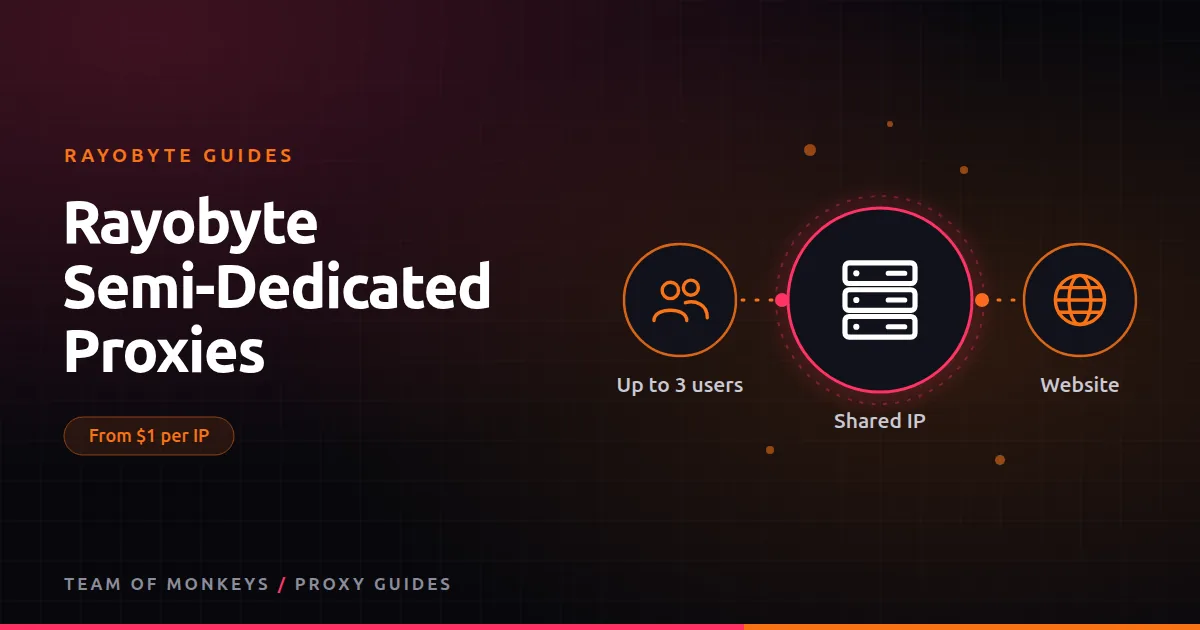
Rayobyte's semi-dedicated proxies are datacenter IPs shared by at most three customers. That's a middle ground between a fully dedicated proxy, used only by you, and the shared proxies some providers sell to many users at once. Capping the number of users keeps the IP's reputation more predictable while cutting the price by more than half.
Pricing and locations
At the time of writing:
| Location | 5 to 99 IPs | 100 to 999 IPs | 1,000 to 4,999 IPs |
|---|---|---|---|
| US and Canada | $1.00 | $0.85 | $0.75 |
| Nine other countries | From $1.20 | Same volume discounts | Same volume discounts |
Enterprise pricing starts at $0.50 per IP. Semi-dedicated ISP IPs are also available on request in the US, UK, Canada and Germany. As with other static products, bandwidth is unmetered under fair use. See Rayobyte pricing explained.

The trade-off
Sharing an IP has three consequences:
- Reputation is shared. If another user hammers a site you also visit, that site may slow down or block the IP for everyone.
- Target overlap matters. Rayobyte limits the number of users, but you can't control what the other two do.
- Capacity is shared. The IP's connection is used by up to three customers, though for most workloads you won't notice.
In exchange you pay about $1 instead of $2 to $3 for a dedicated US IP. For many jobs, that's a good deal.
Residential tip: You can test most of this guide for free: Rayobyte offers a no-card trial on Premium Residential, rotating ISP and rotating datacenter proxies. Move to a paid plan once the pilot works. See dedicated vs semi-dedicated Rayobyte proxies.
When semi-dedicated is a good fit
- Lenient targets where one IP's reputation hardly matters.
- SEO tools and monitors that make light, regular requests.
- Budget projects that need many fixed IPs, such as distributing requests across 500 addresses for under $500 a month.
- Development and testing, where you want stable IPs without dedicated prices.
- Personal use like browsing from another region.
When to pay for dedicated instead
- Accounts. Never share an IP across someone else's accounts and yours. Use static ISP or dedicated IPs.
- Sneaker sites and ticketing, where other users may target the same sites as you.
- Whitelisted access, where a partner expects only your traffic from an IP.
- Anything where one block costs you real money.
We compare the two side by side in dedicated vs semi-dedicated Rayobyte proxies.
Getting the most from them
- Spread requests across all IPs in the list rather than leaning on a few.
- Keep per-IP request rates modest; you don't want to be the user who burns the IP.
- Replace IPs that start failing consistently. See replacing Rayobyte IPs.
- Monitor success rates per target, and move any target that struggles to dedicated or rotating products.
Proxy tip: For a second opinion on hard targets, run the same test through Geonode residential proxies, which support sticky sessions up to 24 hours and ASN targeting. We compare the two in Rayobyte vs Geonode.
How it compares
Webshare's shared datacenter proxies are cheaper again (100 IPs from $2.99 a month at the time of writing), but they're shared more widely. Webshare also sells private and dedicated tiers. If you want a strict cap on sharing, Rayobyte's three-user limit is a clear rule. See Rayobyte vs Webshare: shared vs semi-dedicated and our guide to cheap datacenter proxies.
For the bigger picture beyond our three partners, read our best proxies buyer's guide, and see cheap proxies for ways to cut cost per successful request.
Budget tip: For jobs where a fixed IP list is enough, Webshare is one of the cheapest options: shared datacenter proxies are sold by the IP, and static residential (ISP) proxies cost well under a dollar per IP per month at the time of writing. More in Webshare datacenter proxies.
Key takeaways
- Semi-dedicated IPs are shared by up to three users and cost from $1 per IP in the US and Canada.
- They suit lenient targets, monitors and budget projects.
- Avoid them for accounts, sneakers, ticketing and whitelisting.
- Bandwidth is unmetered under fair use.
FAQ
How many people share a semi-dedicated IP?
Up to three customers in total, according to Rayobyte.
Can I choose countries?
Yes. The US and Canada start at $1 per IP and nine other countries from $1.20 at the time of writing.
Are semi-dedicated ISP proxies available?
Yes, on request in the US, UK, Canada and Germany. Prices are quoted by sales.
Sources and further reading
Independent references that back up the points above, from standards bodies, governments, universities and non-profits. They open in a new tab.
- Bandwidth (computing) (Wikipedia): What bandwidth means, the unit most residential proxies are priced by.
- Carrier-grade NAT (Wikipedia): How mobile carriers share one public IP between many users.
- Wireshark (Wireshark Foundation): The open-source packet analyser for checking what traffic leaves your machine.
- IPv4 Depletion and Transfers (ARIN): Background on IPv4 run-out, which is why IPv4 proxies cost more than IPv6.
- RFC 9293: Transmission Control Protocol (TCP) (IETF / RFC Editor): The current TCP specification, the transport under HTTP and SOCKS proxies.
Editorial note: Proxy providers change their pools, features and prices often, so treat any figures here as typical ranges at the time of writing and confirm current terms with the provider before you buy.